
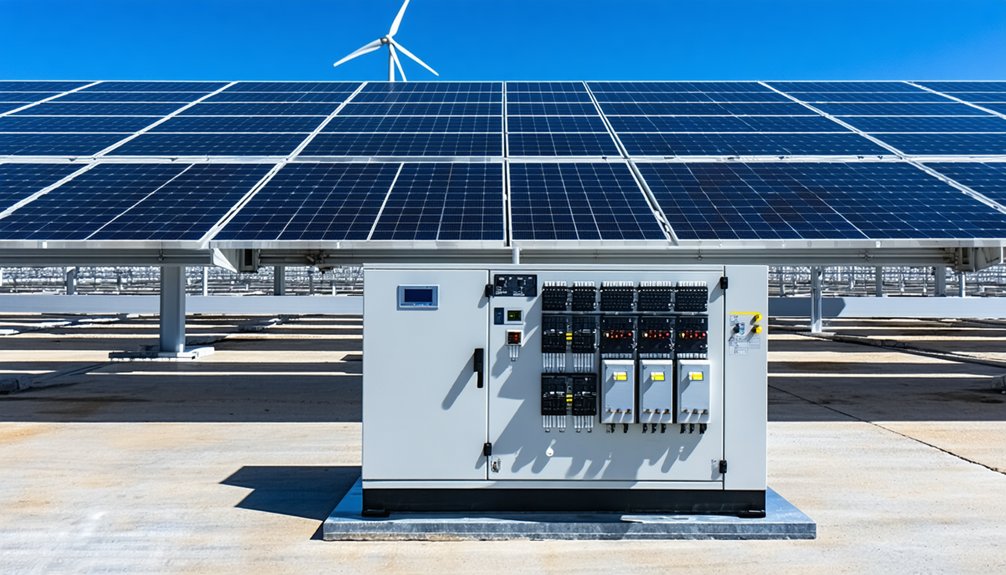

Sustainable technology cuts energy use by embedding real‑time IoT sensors and smart meters that continuously monitor electricity and emissions, instantly adjusting lighting, HVAC, and equipment via edge AI. Smart thermostats and demand‑response systems further trim waste by adapting set‑points to occupancy and price signals, achieving 8‑15 % cost reductions. Renewable integration and on‑site storage shift loads to clean, low‑carbon power, while automated analytics uncover hidden inefficiencies. Continued exploration reveals deeper insights into these mechanisms.
Key Takeaways
- Real‑time IoT monitoring and edge analytics enable instant load adjustments, cutting waste and lowering electricity use by up to 30%.
- Smart thermostats and HVAC demand‑response systems automatically modulate temperature, reducing heating and cooling energy consumption 8‑12% on average.
- Integrated renewable generation with storage shifts demand to clean, low‑cost power, decreasing reliance on fossil peakers and overall grid emissions.
- Policy incentives, carbon pricing, and corporate sustainability commitments accelerate adoption of efficient technologies, driving widespread energy reductions.
- Continuous data feedback and AI‑driven optimization create shared stewardship, identifying inefficiencies and preventing downtime, further improving energy performance.
How Green‑Tech Smart Meters & IoT Sensors Cut Real‑Time Energy Waste?
Leveraging real‑time monitoring, green‑tech smart meters and IoT sensors transform energy management from periodic estimation to instantaneous control.
By feeding zone‑level electricity data into edge processing units, systems can execute occupancy analytics that adjust lighting, HVAC, and equipment power the moment a space is vacated.
This granular visibility eliminates the lag of monthly billing, delivering 10‑30 % consumption cuts in commercial buildings and up to 12 % savings in households.
IoT energy monitoring can reduce energy consumption by 10–30% in commercial buildings.
Anomalous spikes are flagged instantly, enabling proactive fault detection that slashes downtime by half.
The continuous feedback loop creates a shared sense of stewardship among occupants, reinforcing community goals while driving measurable waste reduction.
behavioral change drives further savings.
The report forecasts that IoT operations in 2030 will save more than eight times the energy they consume, highlighting a massive net gain in sustainability.
How Green‑Tech Smart Thermostats Deliver Bigger Savings Than Traditional Controls?
Optimizing indoor climate through continuous, sensor‑driven adjustments, green‑tech smart thermostats achieve markedly higher savings than conventional set‑point controls. By integrating occupancy algorithms, these devices detect presence and automatically trigger adaptive setbacks, reducing HVAC runtime by 4‑8 % during unoccupied periods. ENERGY STAR‑certified models demonstrate an average 8 % reduction in heating and cooling bills, with Nest Learning Thermostats reaching 12 % and 15 % savings on heating and cooling respectively. Pre‑heating and pre‑cooling during peak demand further lower consumption, while demand‑response integration aligns temperature profiles with real‑time electricity pricing. Homeowners experience rapid payback—often under two years—thanks to monthly bill reductions that offset device costs, reinforcing a shared commitment to sustainable living. Learning capabilities enable the thermostat to automatically adjust settings for comfort and energy conservation. Participants were willing to sacrifice small amounts of comfort for modest monetary savings, demonstrating consumer willingness to cede control to the algorithm. The program requires a lower 95% confidence limit of weighted national average savings of at least 8 % for heating.
How On‑Premises Green Tech Can Slash Your CO₂ Footprint?
Smart thermostats illustrate how localized, sensor‑driven control can cut energy use, and the same principle scales to whole‑building and data‑center operations. On‑premises green tech leverages on‑site analytics and localized monitoring to capture granular emissions data from IoT sensors, edge processors, and AI models. By integrating this stream with ERP and EMS platforms, facilities can automatically adjust cooling, lighting, and compute loads, achieving lower PUE values and measurable CO₂ reductions. The North American market, already surpassing $2.3 billion, projects a 10 % CAGR as regulatory pressure and carbon‑pricing incentives intensify. Real‑time dashboards empower stakeholders to align with sustainability targets, fostering a shared commitment to decarbonization across residential, commercial, and IT sectors. Data center emissions are heavily influenced by the electricity grid mix at each location. The solutions segment is expected to grow at a ~10 % CAGR through 2034, driven by demand for customizable, on‑site emissions analytics. The cloud segment is projected to capture the highest share of the market by 2035, reflecting its role in optimizing renewable energy usage and centralizing IT infrastructure.
How Renewable Power Growth Enhances Green‑Tech Energy Reduction?
Amid the accelerating shift toward clean power, the surge in renewable generation directly amplifies the impact of on‑premises green‑tech solutions. Rapid expansion of solar, wind, and battery storage—projected to add 62 % more capacity in 2026 than in 2025—creates abundant low‑carbon electricity for localized systems. Grid integration of these resources reduces reliance on fossil‑fuel peakers, allowing enterprises to align demand with clean supply.
Precise capacity planning, informed by the 36.3 % renewable share of U.S. utility‑scale capacity and the $2.2 trillion renewable investment in 2025, enables facilities to size solar‑plus‑storage assets that meet operational needs while cutting consumption. The resulting synergy lowers overall energy use, strengthens resilience, and fosters a shared commitment to a sustainable, low‑emission future. U.S. built 54 GW of new utility‑scale generation and storage capacity in 2025, the most in over two decades.
How Energy Storage Enables Dispatchable Clean Power for Green‑Tech Systems?
The rapid expansion of renewable generation creates abundant low‑carbon electricity, but its intermittent nature limits direct use in on‑premises green‑tech systems. Energy storage bridges this gap by converting surplus power into chemical form within electrochemical cells, then releasing it on demand through battery dispatchability.
Lithium‑ion and sodium‑ion modules, integrated with DC‑coupling and advanced management systems, provide instant response and high efficiency for residential, commercial, and utility applications. Short‑duration units smooth daily fluctuations, while long‑duration technologies such as pumped hydro, compressed‑air, and gravity‑based storage extend discharge periods to weeks or months, ensuring continuous clean power.
How Green‑Tech Boosts Economic Output per Energy Unit?
By harnessing renewable generation and advanced efficiency measures, green‑tech systems raise the amount of economic output generated per unit of energy consumed.
In 2024, global energy intensity fell 1 %, while OECD nations achieved a 26 % lower intensity than the world average, illustrating heightened productivity per‑energy.
Renewable‑heavy grids, now over 90 % of new capacity, link higher per‑capita electricity generation to rising GDP per capita, reinforcing the economic payoff of clean power.
Investment trends amplify this effect: $2.2 trillion in clean‑energy spending in 2025, a market projected to reach $140 billion by 2034, fuels technology spillovers that spread efficiency gains across sectors.
Decoupling of growth from energy use—evident in offshore production shifts—further boosts output while curbing consumption, cementing green‑tech’s role in a more productive, inclusive economy.
Why Green‑Tech Adoption Is Accelerating Globally?
Why is green‑tech adoption accelerating worldwide?
Robust market data shows the sector expanding from $35.43 billion in 2026 to $128.25 billion by 2032, a 23.58 % CAGR, while alternative forecasts predict even larger scales.
Policy incentives—tax credits, carbon pricing, and infrastructure grants—have been codified across the Americas, Europe, and Asia, creating a uniform regulatory push.
Simultaneously, corporate commitments to net‑zero targets have intensified, with large enterprises embedding sustainability into core strategy.
Technological breakthroughs in AI, IoT, and blockchain deliver real‑time optimization and transparent carbon accounting, reinforcing investor confidence and consumer expectations.
Regional dynamics, from U.S. digital hubs to China’s solar dominance, illustrate a coordinated global shift, fostering a shared sense of purpose among stakeholders.
How Demand‑Response Keeps Industrial Loads Efficient With Green‑Tech?
Accelerated green‑tech adoption has created a landscape where industrial demand‑response (DR) programs become a cornerstone of efficient load management. By interpreting grid signaling, facilities execute load prioritization that shifts non‑critical processes to off‑peak windows while preserving core production. Advanced meters and AI‑driven platforms automate adjustments, delivering up to 30 % cost reductions during peaks and contributing to national savings of over 50 % of peak demand.
Incentives averaging $9,000 per year motivate participation, aligning corporate sustainability goals with tangible financial benefits. Continuous monitoring uncovers inefficiencies, feeding back into energy‑efficiency initiatives that lower intensity by 25 % across a decade. This integrated approach stabilizes the grid, supports renewable integration, and fosters a shared commitment to a low‑carbon industrial future.
References
- https://bcse.org/new-study-shows-american-sustainable-energy-technologies-are-ready-meet-increasing-energy-demand/
- https://css.umich.edu/publications/factsheets/built-environment/information-technology-factsheet
- https://data.worldbank.org/indicator/EG.FEC.RNEW.ZS
- https://onlinelibrary.wiley.com/doi/full/10.1002/sd.2978
- https://www.fortunebusinessinsights.com/green-technology-and-sustainability-market-102221
- https://www.un.org/sustainabledevelopment/energy/
- https://www.nanogrid.com/blog/iot-energy-monitoring-cut-energy-use-automate-esg
- https://patentpc.com/blog/iot-energy-savings-smart-metering-consumption-reduction-data
- https://iottechnews.com/news/iot-technology-will-save-eight-times-the-energy-it-consumes-by-2030-new-report-shows/
- https://iotjourney.orange.com/en/news/orange-iot/power-play-reducing-the-end-to-end-energy-impact-of-iot-systems-1745494728997