
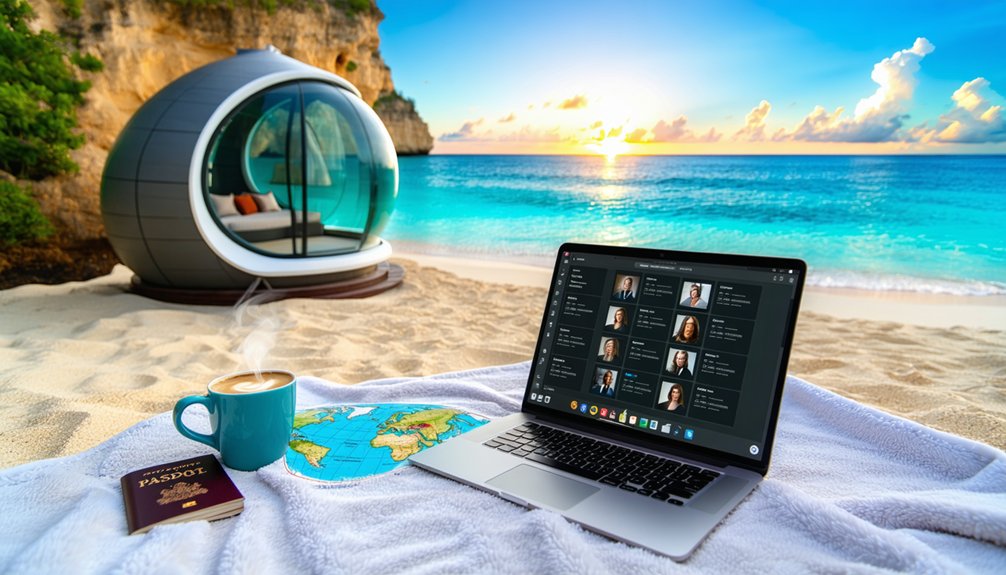

Hybrid schedules let workers split time between office and home, turning short trips into month‑long stays. They demand reliable high‑speed internet, power redundancy, and local SIMs to keep meetings seamless across time zones. Wellness‑focused retreats and co‑living spaces provide productivity‑boosting amenities and burnout relief. Specialized remote‑work visas and AI‑driven planning tools streamline destination selection, budgeting, and logistics. Continued exploration reveals how these factors reshape travel patterns and the industry.
Key Takeaways
- Hybrid work models let employees blend office duties with up to four remote days, turning short trips into month‑long stays.
- Remote workers prioritize reliable high‑speed internet, stable mobile networks, and power redundancy over traditional leisure amenities.
- AI‑driven travel planning tools, trusted by 78 % of remote travelers, streamline destination selection based on connectivity and wellness options.
- Specialized remote‑work visas and tax incentives in over 70 countries shape destination choices more than climate or culture.
- Wellness‑focused retreats and co‑living communities provide physical renewal and social belonging, combating remote‑work fatigue.
Remote‑Work Travel Priorities: What’s Changing?
Amid the surge of hybrid work, remote‑work travel priorities have shifted from occasional getaways to strategic, long‑term location choices. Professionals now evaluate destinations through the lens of time zone etiquette, ensuring that meetings with North‑American teams remain seamless, while also confirming reliable local sim connectivity for uninterrupted communication.
The dominance of hybrid schedules—52 % of U.S. workers split time between home and office—has turned flexibility into a prerequisite for belonging, prompting workers to seek environments that support sustained collaboration without sacrificing personal rhythm. Infrastructure considerations, such as high‑speed internet and stable mobile networks, outweigh leisure amenities, as employees prioritize productivity gains and social integration within a globally distributed workforce. This pragmatic focus reshapes travel decisions, aligning personal aspirations with corporate expectations. Over 70 countries now offer specialised visas for remote workers, expanding the pool of viable long‑term destinations. Hybrid work has become the dominant model for the American workforce. Gen Z travelers are increasingly prioritizing sustainability in their remote‑work location choices.
Work‑From‑Anywhere Destinations: Must‑Have Amenities
Where do digital nomads find the essential blend of connectivity, comfort, and community? They gravitate toward locales that guarantee secure connectivity and robust power redundancy while offering affordable living.
In Bali’s Canggu and Ubud, high‑speed Wi‑Fi pairs with coworking spaces designed for remote work, and Cape Town’s rentals include backup generators that offset load‑shedding.
Seattle and Boston provide city‑wide fast internet and reliable grids, while Dubai’s premier coworking hubs combine luxury with uninterrupted service.
Lisbon and Porto deliver cost‑effective housing and vibrant coworking scenes, and Mexico City’s Roma and Condesa neighborhoods balance cultural richness with dependable Wi‑Fi.
These amenities create a sense of belonging, allowing nomads to sustain productivity and community across continents. SpainDigital income requirement]] Spain is €2,760 per month, with higher thresholds for dependents.
Medellín offers a spring‑like climate that enhances year‑round comfort for remote workers.
Portugal’s Schengen access enables easy travel throughout Europe while maintaining a stable remote‑work base.
How Remote‑Work Visas Influence Destination Choice
By aligning visa criteria with financial, fiscal, and residency considerations, remote‑work permits shape nomadic destination decisions more decisively than climate or cultural allure. Digital nomads evaluate tax incentives and visa duration alongside income thresholds, seeking ecosystems that preserve earnings while granting stability.
Spain’s top‑ranked status combines generous EU tax exemptions with one‑year renewable permits, appealing to those prioritizing fiscal certainty. Portugal’s D8 visa demands €3,680 monthly income, yet offers a two‑year term and pathways to permanent residency, offset by IFICI+ tax considerations.
Malta and Germany provide moderate income requirements and multi‑year options, reinforcing their attractiveness. Countries such as Costa Rica and Colombia leverage 0 % foreign‑income tax and short‑term visas, but limited renewal prospects reduce long‑term belonging potential.
Consequently, remote‑work visa structures drive destination choice more than scenery, anchoring nomads to jurisdictions that align income, tax, and residency goals. The Beckham Law in Spain offers a 0 % tax on foreign earnings for up to six years. The growing rise of digital nomads in the Global South reflects shifting preferences toward affordable, tax‑friendly environments. Average CO₂ per nomad is 1,380 kg/y, 72 % less than the average American travel/commuting emissions.
Why Hybrid Schedules Turn Trips Into Month‑Long Stays
Leveraging the flexibility of hybrid schedules, employees now blend three‑day office commitments with up to four days of remote work, turning short business trips into month‑long stays. Companies that adopt hybrid models report a 300% surge in workations, as workers extend business trips into personal leisure periods.
Extended stays enable commute minimization, allowing employees to consolidate travel and reduce frequent, costly trips. Data show hybrid workers enjoy 45% more deep‑work hours and 15% fewer meetings, reinforcing the appeal of longer, uninterrupted periods away from the office.
With 64.4% of organizations already operating hybrid and 91% citing it as essential for recruitment, the trend toward month‑long stays is reshaping travel expectations, fostering community among itinerant professionals, and supporting sustained productivity. Remote and hybrid work models increase purposeful travel for off‑site retreats, team gatherings, and collaboration.
Productivity‑Friendly Accommodations: Co‑Living & Live‑Work Hotels
Amid the surge in hybrid work schedules, productivity‑friendly accommodations have emerged as a pivotal solution for mobile professionals. Co‑living complexes and live‑work hotels now combine private work zones with shared social infrastructure, delivering high‑speed internet, fully furnished rooms, and on‑site housekeeping. Flexible lease terms and curated meal plans appeal to digital nomads, young professionals, and students seeking cost‑effective urban bases. Privacy pods provide quiet focus areas, while community events foster networking and a sense of belonging.
Integrated coworking spaces meet demanding work standards, and double‑occupancy options reduce rent while encouraging peer collaboration. The market, valued at $10.31 billion in 2026, is projected to surpass $31 billion by 2034, driven by this blend of productivity and community.
How Remote‑Work Savings Expand Your Travel Budget
A typical remote worker can redirect $6,000‑$12,000 of yearly savings—derived primarily from eliminated commuting costs, reduced meals out, and the disappearance of a professional wardrobe—directly into travel.
These budget reallocations stem from a clear cost breakdown: commuting, food, and attire collectively account for the majority of the $6‑$12 K range, while daily time gains translate into indirect financial benefits.
By channeling this surplus into leisure monetization, workers can extend trips, upgrade accommodations, and blend work with longer bleisure stays.
The trend aligns with broader corporate travel growth, as global travel budgets rise 5 % and hotel and airfare prices increase modestly.
Consequently, remote employees experience enhanced belonging through shared experiences, while their expanded travel budgets reinforce a lifestyle that rewards flexibility and community.
Wellness‑Focused Destinations for Burnout‑Prone Travelers
From bustling cityscapes to tranquil coastlines, wellness‑focused destinations now serve as strategic refuges for travelers battling burnout. In India and Sri Lanka, Ayurvedic Immersion programs combine Panchakarma detox, herbal therapies, and daily yoga to reset physiological rhythms. Portugal’s coastal resorts blend sun‑soaked fitness sessions with spa treatments, while Thailand’s affordable retreats offer meditation, herbal compresses, and Sound Healing circles using Tibetan singing bowls.
Costa Rica and Bali cater to digital nomads with plant‑based cuisine, yoga decks, and reliable internet, fostering community belonging. Mexico’s vibrant retreats integrate hot‑yoga, hiking, and shamanic sound baths, whereas Croatia’s Mediterranean villages provide long‑term visas and wellness collectives. These curated experiences deliver mental clarity, emotional grounding, and physical renewal, positioning them as essential antidotes to remote‑work fatigue.
AI Tools That Simplify Remote‑Work Travel Planning in 2026
Wellness‑focused retreats have highlighted the need for seamless logistics, prompting remote‑workers to turn to AI‑driven platforms that guarantee every stage of travel planning.
In 2026, AI concierge services such as Roam Around, iplan.ai, and TripPlanner.ai generate personalized itineraries by ingesting preferences, budgets, and time constraints, while TravelDiari’s multi‑agent system coordinates group travel for up to 50 participants.
Real‑time updates from TripIt, Destinations.ai, and iPlan AI keep flights, hotels, and local events current, reducing disruption.
Offline syncing via Wonderplan, Tripbot, and Stardrift ensures itineraries remain accessible in low‑connectivity zones, preserving workflow continuity.
Adoption statistics show 90 % awareness and 78 % reliance on AI recommendations, underscoring trust and the growing sense of community among digital nomads.
References
- https://blog.nomadstays.com/?p=8001
- https://www.deloitte.com/us/en/insights/industry/transportation/travel-hospitality-industry-outlook.html
- https://www.worktime.com/blog/statistics/remote-work-statistics
- https://www.simon-kucher.com/en/insights/global-travel-trends-2026
- https://www.roberthalf.com/us/en/insights/research/remote-work-statistics-and-trends
- https://www.phocuswright.com/Travel-Research/Research-Updates/2026/Travel-Forward-Data-Insights-and-Trends-for-2026
- https://www.relocate.world/articles/remote-work-trends-2026-jobs-abroad
- https://www.splashtop.com/blog/remote-work-trends-2026
- https://www.morganstanley.com/insights/articles/corporate-travel-trends-2026
- https://www.talenteverywhere.org/Mobility-News/Article/international-mobility-trends-rethinking-travel-assignments-and-remote-work