
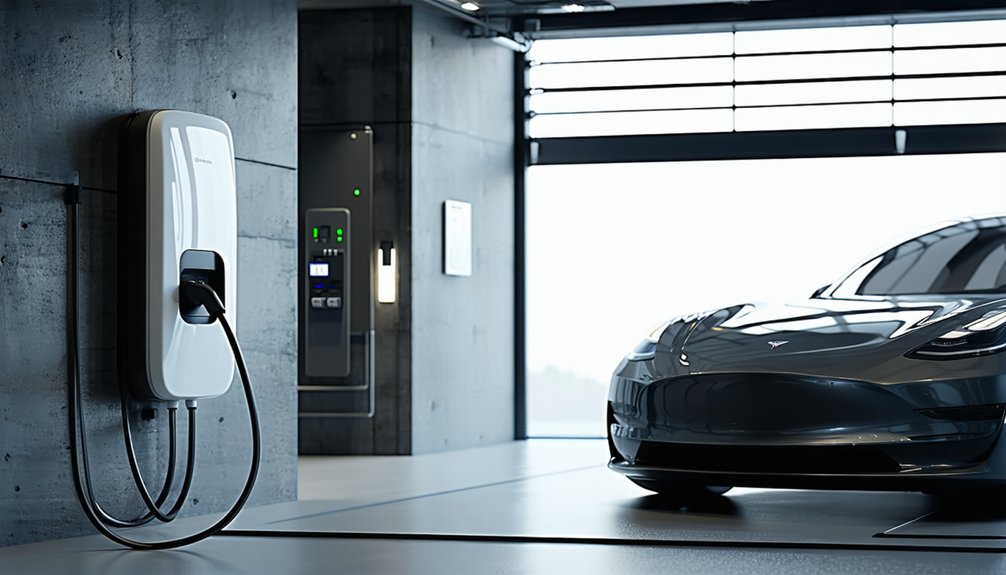

A home EV charger needs a dedicated circuit, so the electrician must verify panel amperage and make certain at least 125 % of the charger’s load can be supplied. NEC rules require proper grounding, UL‑listed equipment, and weather‑proof enclosures, with hard‑wired units offering higher capacity and durability than plug‑in models. Planning conduit, mounting location, and permits early avoids costly retrofits, while budgeting for breakers, conduit, and labor helps prevent surprises. Continuing will reveal how to future‑proof the installation.
Key Takeaways
- Verify your home’s panel capacity and upgrade if necessary; a 150‑amp service often suffices for a 40‑amp EV charger, but 200‑amp panels provide ample headroom.
- Install a dedicated 125 %‑rated branch circuit (typically 40 A or 50 A) with proper grounding, GFCI protection, and weather‑proof enclosure per NEC.
- Plan conduit and wiring routes early, using oversized or extra conduit to simplify future expansions or additional chargers.
- Choose between hard‑wired (higher durability, up to 48 A) and plug‑in (easier DIY) units, ensuring the selected option meets local code and safety standards.
- Obtain required permits, coordinate with utilities for load management, and schedule inspections to confirm compliance before energizing the charger.
How to Assess Your Home’s Electrical Capacity for an EV Charger
When evaluating a home’s ability to support an EV charger, the first step is to determine the panel’s amperage rating and overall service size, as these figures define the maximum current the electrical system can safely deliver.
A 100‑amp panel, common in older houses, often cannot accommodate a 30‑60 amp Level 2 charger without load forecasting or meter upgrades. A 150‑amp service may suffice if major appliances are modest, while a 200‑amp panel typically provides ample headroom for modern loads and a dedicated 40‑amp circuit.
Homeowners should sum breaker ratings, note frequent trips, and consider air‑conditioning or dryer draw. Consulting a licensed electrician guarantees accurate load forecasting, identifies the need for meter upgrades, and confirms that the panel can reliably support the charger’s demand. Overloaded panels can cause breaker trips, overheating, or fire hazards. Adding a dedicated circuit ensures the EV charger operates independently of other household loads. Panel upgrades are often necessary for older homes with limited capacity.
How NEC Rules Influence Your EV‑Charger Installation
By aligning the installation with the National Electrical Code, homeowners guarantee that every component of an EV‑charging system meets rigorous safety and performance standards. The 2023 code updates require a dedicated branch circuit for any outlet exceeding 16 A or 120 V, reinforcing the rule that no other devices share the circuit. Proper grounding, UL‑listed equipment, and weather‑proof enclosures protect both the charger and the home’s electrical network. Height and location specifications—18 inches indoors, 24 inches outdoors—ensure accessibility while preventing accidental damage. Local jurisdictions typically mandate an electrical permit and schedule inspection intervals to verify compliance. Adhering to these NEC rules fosters a reliable, community‑trusted charging environment that integrates seamlessly with existing wiring. The NEC also mandates that charging stations be installed on a dedicated circuit. to the charger’s maximum continuous load. The 2023 revision excludes Level 1 outlets from the mandatory individual‑circuit requirement. Most jurisdictions require an electrical permit for a new EV charging circuit at home.
How to Choose Hard‑Wired vs. Plug‑In EV Chargers
Choosing between a hard‑wired and a plug‑in EV charger hinges on performance, installation complexity, durability, safety, and long‑term value.
Hard‑wired units deliver up to 48 amps and 19.2 kW, adding roughly 44 miles per hour to a Tesla Model Y, while plug‑in models cap at 40 amps and 9.6 kW, yielding about 37 miles.
The permanent wiring eliminates plug wear, improves installation aesthetics, and offers superior connector compatibility for harsh weather.
Plug‑in chargers use a NEMA 14‑50 outlet, allowing DIY setup if the outlet exists, but introduce loose connections and potential tripping.
Professional hard‑wired installation, though requiring an electrician, reduces long‑term maintenance, enhances safety with dedicated GFCI protection, and typically adds lasting home value.
Hardwired chargers often require a panel upgrade to provide at least 10 amps extra capacity for safe operation. Moreover, a dedicated circuit ensures the charger operates without shared load interruptions.
Hard‑wired installations also benefit from lower nuisance‑tripping rates due to the absence of a removable plug.
How to Free Up or Add Space in Your EV‑Charger Panel
In many homes, panel space quickly becomes the bottleneck for adding Level 2 EV chargers, so a systematic assessment of existing capacity and breaker slots is essential before any expansion. A homeowner should first inventory available slots and calculate the required 7.2 kVA per EV‑capable space, or 3.3 kVA if an energy‑management system is installed.
If slots are insufficient, panel expansion becomes necessary; this often involves upgrading to a larger service panel and adding a dedicated 50 A branch circuit. Conduit planning is critical: lay oversized or extra conduits during initial trenching, limiting runs to 25 feet, to avoid future digging.
Adjustable‑output chargers starting at 32 A provide scalability, while networked load‑management devices can share capacity across multiple stations, preserving panel readiness for the community of EV owners. Make‑ready parking requirements can affect the number of chargers needed for residential projects.
Best Locations and Mounting Methods for Your EV Charger
Prime placement of an EV charger hinges on balancing protection, convenience, and electrical efficiency.
In a garage, mounting the unit on solid wall studs or masonry keeps it secure, shortens cable length, and preserves ventilation clearance for heat dissipation. Proximity to the electrical panel reduces wiring costs and eliminates extensive wall modifications.
When a garage is unavailable, an outdoor post or wall mount under an overhang protects the charger from rain and lightning while maintaining adequate ventilation clearance. Align the charger with the vehicle’s charging port, typically on the left or right side, and allow a 10‑foot buffer beyond the longest cable length (6‑25 ft) to avoid tension.
Position the unit away from foot traffic, low‑lying water areas, and sprinkler heads to guarantee safe, unobstructed access.
Permits, Utility Coordination, and Dig‑Safety for EV‑Charger Installations
After selecting an ideal mounting location, the next step is to secure the necessary approvals and safeguard the site before any excavation begins. Homeowners must obtain an electrical permit, typically filed by a licensed electrician, to satisfy the National Electrical Code and local ordinances; failure can void insurance and create liability.
Utility coordination is often required for Level 2 chargers, ensuring load management and preventing grid strain, and many states offer utility incentives that offset upgrade costs. Prior to trenching, callers should dial 811 to mark underground lines, and municipalities usually demand proof of this notification.
Inspection timelines are set by the building department, with checkpoints confirming safe digging practices and final NEC compliance before the charger is energized.
Typical Costs for EV‑Charger Panels, Breakers, Conduit, and Labor
A typical home EV‑charger installation can range from $800 to $3,000 for labor and basic materials, while full‑system expenses—including panel upgrades, dedicated breakers, and conduit—often fall between $1,700 and $2,500 for standard Level 2 setups and may climb to $12,000 or more in complex or high‑capacity scenarios.
Panel upgrades, necessary when existing capacity is insufficient, cost $1,000 to $4,000+ for residential units, while a 40‑50 amp double‑pole breaker adds $100 to $500. Conduit runs depend on distance, ranging $500 to $2,000, with trenching for longer spans pushing expenses higher.
Labor averages $800 to $2,500, varying by region and site conditions. Homeowners can offset part of the outlay through energy rebates, and many choose aesthetic covers to blend the hardware with their property’s design, reinforcing a sense of community investment.
Future‑Proofing Your EV‑Charger Setup
By evaluating the existing electrical infrastructure early, homeowners can make certain that their EV‑charger installation remains adaptable to future demands. A qualified electrician should verify panel capacity, conduit space, and breaker sizing at 125 % of the EVSE’s rated load, allowing room for additional circuits or higher‑power chargers.
Selecting equipment that supports OCPP 1.6+ and modular chargers guarantees that network changes or upgrades to Level 2 or DC fast charging can be accommodated without replacing the whole unit. Incorporating solar compatibility during the design phase lets rooftop panels or battery storage feed the charger, reducing grid reliance.
Pre‑installed oversized conduit and ADA‑compliant layout further simplify later expansions, fostering a resilient, community‑focused charging environment.
References
- https://www.youtube.com/watch?v=2G1UzQ2HrDQ
- https://qmerit.com/blog/how-to-install-an-ev-charger-at-home/
- https://www.epa.gov/greenvehicles/getting-started-home-ev-charging
- https://www.energysage.com/ev-charging/install-a-home-charging-station/
- https://cyberswitching.com/complete-guide-ev-charging-station-installation/
- https://www.constellation.com/energy-101/energy-innovation/installing-ev-charger-at-home.html
- https://www.youtube.com/watch?v=87joDusz_ic
- https://www.eaton.com/content/dam/eaton/products/electrical-circuit-protection/circuit-breakers/ev-charging-circuit-breaker/ev-wall-charger-installation-guide-IL91011EN.pdf
- https://eviumcharging.com/blog/ev-charging-station-installation-guide/
- https://www.emporiaenergy.com/blog/a-comprehensive-guide-to-level-2-ev-charger-installation/