
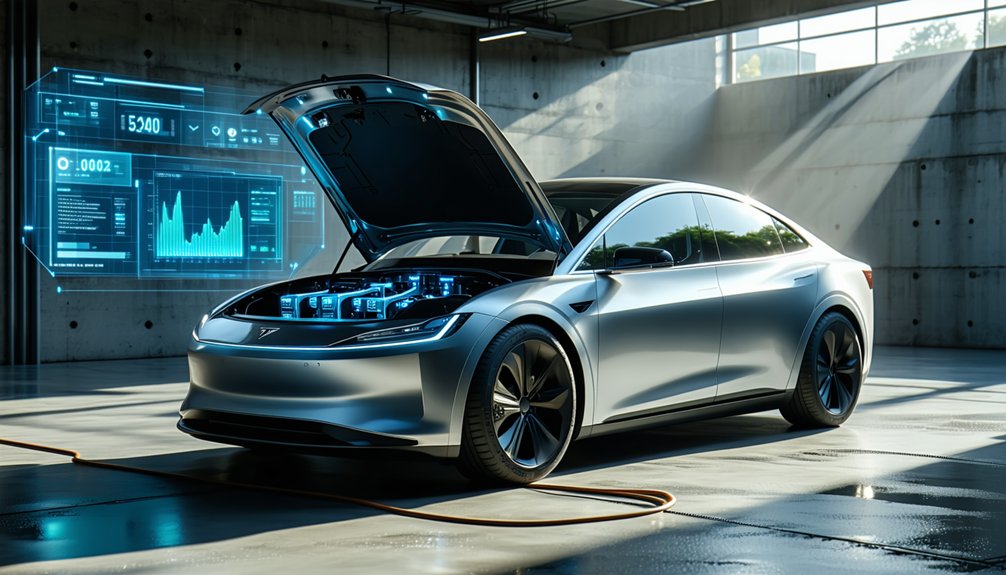

Modern EV batteries now last 12‑15 years, with average annual capacity loss under 2.5 % thanks to chemistry, thermal management, and charging advances. LFP chemistries offer 4,000‑10,000 cycles and slower decay, while NMC provides higher energy density but degrades roughly twice as fast. Active cooling and upgraded BMS keep cells near ideal temperature, reducing heat‑induced aging. Limiting high‑power DC fast‑charging in favor of Level‑2 preserves health. An 8‑year/100 k‑mile warranty guarantees at least 70 % capacity, and further details emerge when the full story is explored.
Key Takeaways
- Advanced thermal‑management systems keep cells near optimal 20‑25 °C, reducing heat‑induced aging and extending cycle life.
- Improved BMS sensor fusion balances voltage and temperature across cells, preventing hotspots and mitigating degradation.
- Adoption of LFP chemistry provides 4,000‑10,000 cycles, slower 2.3 % / yr decay, and higher thermal stability than NMC.
- Charging protocols that limit high‑power DC fast‑charging and favor Level‑2 AC charging cut degradation rates roughly in half.
- Longer warranties (8‑10 years/100k‑150k mi) and second‑life repurposing encourage manufacturers to design batteries for durability and recyclability.
What Is the Typical Lifespan of an EV Battery?
Typically, an electric‑vehicle battery remains functional for 12 to 15 years under normal driving conditions, a range corroborated by the National Renewable Energy Laboratory, the U.S. Department of Energy, and Geotab analysis, which notes an average of 13 years or more.
Warranty data—8 years/100,000 miles for most U.S. models, 10 years for Hyundai/Kia, and extended mileage caps for Tesla—reinforces this timeline.
Degradation proceeds at roughly 2.3 % per year, with capacity staying above 70 % well beyond warranty limits, preserving resale value.
After primary automotive service, many batteries find second‑life reuse in stationary storage, extending utility while supporting community energy goals.
This longevity fosters consumer confidence and strengthens the collective commitment to sustainable mobility. First‑generation EVs show the highest replacement rates, reflecting their older age and earlier battery technology. Thermal‑management systems help maintain optimal temperature ranges, reducing degradation and extending battery life. Fast‑charging can accelerate wear, so limiting its use helps preserve battery health.
What Do Real‑World Data Show About EV Battery Degradation Rates?
Real‑world studies consistently reveal that EV battery degradation averages 2.3 % per year across a sample of 22,700 vehicles and 21 models, a figure that aligns with the 2020 and 2025 analyses and contrasts with the 1.4 % annual rates observed in the 2023 dataset.
The data expose real world variability driven by usage patterns, climate, and charging behavior.
High‑power DC fast charging above 100 kW roughly doubles degradation to 3.0 % versus 1.5 % for low‑power sessions, while hot climates add a 0.4 % annual penalty.
Thermal mapping shows that heat‑induced aging mechanisms dominate during frequent fast‑charging bursts.
Nonetheless, modern EVs retain 81.6 % capacity after eight years, and only 0.3 % of batteries require replacement, underscoring the collective impact of these factors on longevity.
Frequent use of high‑power DCFC sessions accelerates wear, as high‑power charging increases degradation rates by roughly 0.5 % annually.
Higher utilization further contributes to accelerated battery aging.High‑mileage vehicles often show a wider spread in SoH, indicating that mileage alone is not the best predictor of battery health.
How Do NMC and LFP Chemistries Improve EV Battery Lifespan?
The chemistry of an EV’s cathode dictates how quickly its battery ages, and the contrast between nickel‑manganese‑cobalt (NMC) and lithium‑iron‑phosphate (LFP) formulations is especially stark.
LFP delivers superior cycle endurance, routinely reaching 4,000‑10,000 cycles before 80 % capacity loss, and tolerates frequent rapid charging without accelerated degradation. Its high round‑trip efficiency and thermal stability further protect capacity during daily use. Thermal stability reduces the risk of fire propagation in confined spaces.
NMC, while offering higher energy density, provides 800‑2,000 cycles and exhibits a decay rate roughly twice that of LFP, making it more sensitive to deep discharge and full‑state‑of‑charge cycling. Nonetheless, NMC can retain 85‑90 % capacity after a decade of typical mileage.
Together, these chemistries shape EV lifespan, with LFP emphasizing long‑term endurance and charge tolerance, and NMC prioritizing range within a shorter service window. LFP’s lower material cost also contributes to its widespread adoption in energy‑storage applications. LFP’s higher safety rating is demonstrated by BYD’s nail‑through test.
How Do Active Cooling and BMS Upgrades Reduce EV Battery Degradation?
By circulating thermal fluids through micro‑channels and dynamically adjusting cell‑level cooling, active thermal systems keep EV batteries within the 20‑25 °C sweet spot where electrochemical reactions proceed most efficiently.
Integrated thermal management combines dielectric immersion, phase‑change buffers, and liquid‑cooling loops to prevent hotspots that accelerate dendrite growth and electrolyte breakdown.
Simultaneously, upgraded BMS employs sensor fusion to monitor temperature, voltage, and current across every cell, instantly modulating pump speed, fan duty, or heating elements.
This precise feedback loop balances cells, averts thermal runaway, and sustains uniform charge acceptance during high‑power demand.
The result is reduced capacity fade, extended cycle life, and a safety margin that reinforces driver confidence and community trust in electric mobility.
Active cooling is essential because high‑current fast charging generates substantial heat that must be dissipated to avoid temperature spikes.
How Does Fast‑Charging Versus Level‑2 Charging Affect EV Battery Health?
Typically, fast‑charging (DC‑FC) and Level‑2 (AC) charging exert markedly different stresses on EV battery health. Level‑2 delivers 10‑30 miles per hour, generates modest heat, and keeps the state of charge within the 20‑80 % window that manufacturers flag as optimal. Its gentle voltage cycles support long‑term capacity, making it the preferred choice for everyday charging etiquette.
In contrast, DC‑FC can push a pack from 0 % to 80 % in 20 minutes, exposing cells to high‑power (>100 kW) bursts that raise temperature and accelerate chemical wear. When DC‑FC sessions exceed 12 % of total charging, annual degradation climbs from 1.5 % to 2.5 %, a 16 % increase versus AC fast. Owners who balance peak shaving with limited fast‑charge events and prioritize Level‑2 for routine top‑ups preserve battery health and foster a shared sense of stewardship.
How Do Mileage, Fast‑Charging, and Heat Wear Batteries?
Accelerating mileage, frequent high‑power DC fast‑charging, and exposure to elevated temperatures each impose distinct, quantifiable stresses that accelerate lithium‑ion battery wear. Data from 22,700 vehicles show an average annual degradation of 2.3 %; high daily mileage pushes this to 2.7 % for multi‑purpose models, while low‑power Level 1/2 charging limits loss to 1.5 %.
Fast DC charging above 100 kW doubles the rate to roughly 3 % and leaves only 76 % capacity after eight years. Heat adds another 0.4 % per year in climates with many days above 25 °C, overruling the 68‑86 °F prime range.
These factors compel urban cycling fleets to adopt balanced charging strategies and accelerate fleet turnover, ensuring collective reliability and shared confidence in EV technology.
Which Chemistry: NMC or LFP: H Up Better for EV Battery Lifespan?
When evaluating long‑term durability, lithium‑iron‑phosphate (LFP) outperforms nickel‑manganese‑cobalt (NMC) chemistry in virtually every metric that governs battery lifespan.
LFP delivers 3,000–6,000+ cycles before 80 % capacity, roughly two to three times the cycle life of NMC’s 800–2,500 cycles, and maintains a slower decay rate even under 100 % daily charge. Its thermal stability, with a flashpoint near 500 °C, far exceeds NMC’s 210 °C, reducing reliance on complex BMS cooling.
Although NMC offers 20–30 % higher energy density (≈250 Wh/kg vs. LFP’s ≈160 Wh/kg), the safety and longevity advantages of LFP align with fleet operators seeking high‑mileage reliability, easier battery recycling, and smoother grid integration.
What Does an 8‑Year/100k‑Mile Warranty Actually Cover for EV Batteries?
How far does an eight‑year, 100‑k‑mile warranty really protect an EV’s battery?
It guarantees that the high‑voltage pack retains at least 70 % of its original capacity, covering defects in materials, workmanship, and premature capacity loss.
If capacity falls below the threshold, the manufacturer may replace the pack or perform prorated repairs, charging the owner only for the portion of wear already incurred.
The coverage period runs from the vehicle’s first in‑service date, not the purchase date, and typically transfers to subsequent owners, preserving value for the new driver.
Exclusions include abuse, extreme climates, and excessive fast‑charging practices.
Across brands, the warranty often exceeds standard power‑train protection, reinforcing consumer confidence in long‑term EV ownership.
References
- https://coltura.org/electric-car-battery-life/
- https://electrek.co/2026/02/18/most-ev-batteries-outlast-their-cars-real-world-data-shows/
- https://www.electriccarscheme.com/blog/how-reliable-are-electric-cars
- https://www.eurekalert.org/news-releases/1118032
- https://www.geotab.com/blog/ev-battery-study/
- https://www.caranddriver.com/features/a70112357/electric-car-batteries-how-long-can-they-last/
- https://www.recurrentauto.com/research/how-long-do-ev-batteries-last
- https://unitil.com/blog/electric-car-battery-life-fact-vs-fiction
- https://www.geotab.com/blog/ev-battery-health/
- https://news.stanford.edu/stories/2024/12/existing-ev-batteries-may-last-up-to-40-longer-than-expected